Jibleya
The Legend of William OhJibleya are a distinct people encountered amid the ruined upper levels of Oilton, recognizable by their translucent pink flesh and shiny skin. Naturally resistant to poisons and acids, they have developed a strong cultural association with alchemy. In a city being overrun by the rapidly multiplying Tangled, their bodily resilience, technical orientation, and willingness to cooperate make them more than a minor monster faction: they are part of the improvised coalition attempting to survive and understand a cascading disaster.
Appearance and Alchemical Adaptation
Jibleya possess somewhat distended, translucent pink flesh, with shiny skin stretched tightly over their bodies like a grape. The first visible sign of their presence may be a spear carried by a small, glossy pink hand, as when one confronted Will in the ruined throne room. Their resistance to poisons and acids is not merely a descriptive curiosity. It helps explain why Jibleya tend toward alchemy and later allows them to use corrosive substances in combat without being defined solely by ordinary human physical limits.
That adaptation places Jibleya on an unstable boundary between biology and craft. Their bodies make certain substances less dangerous to them, while their social direction toward alchemy turns that natural trait into a specialized practice. The resulting identity is both physiological and cultural: Jibleya are not simply creatures with an unusual appearance, but a people whose environment, bodies, and technical expertise have reinforced one another.
Survival in Oilton
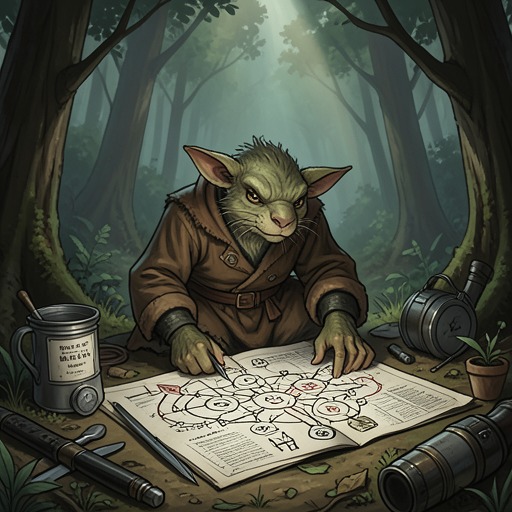
When Will and Loth enter the damaged throne room, Jibleya emerge from the darkness and identify themselves as one of the groups occupying the area. Kobolds also appear from beneath deceptively orderly stools, revealing that the apparent emptiness of the room is an ambush or defensive arrangement rather than evidence that the city has been abandoned. The Jibleya and kobolds have been forced into close proximity by the Tangled stalking Oilton.
A Jibleya leader explains that the two peoples normally do not get along. Their ordinary rivalry has been subordinated to a more immediate demographic crisis: there are far fewer Jibleya than before, and the survivors can no longer afford to fight one another over loot. The group Will sees numbers only around two dozen individuals, and the leader confirms that it used to be much larger. Their alliance is therefore not founded on reconciliation or trust. It is a scarcity-driven truce, created by losses severe enough to make old hostilities impractical.
The Jibleya provide the coalition with vital information about the Tangled. According to their data, approximately thirteen thousand Tangled are stalking the city, up from just under nine thousand three days earlier, with the population increasing by 14.28 percent per day. This turns the creatures from a collection of dangerous encounters into a rapidly expanding system-level threat. The Jibleya’s observations give Loth and the others a measurable basis for planning, even as the growth rate implies that delay itself is dangerous.
Conflict with the Tangled
Jibleya participate directly in the defense of the city. When a young man’s apparent daze gives way to hatred and his body erupts into a sprawling mass of torsos and limbs, the Jibleya and kobolds respond through a coordinated trap. Thick wires shoot from the walls, severing limbs and pinning the creature in place; the surrounding walls then open into murder holes filled with defenders. Jibleya and kobolds stab the immobilized monster together, using numbers and prepared infrastructure to compensate for the Tangled’s extraordinary regeneration.
Spears alone do not finish the creature, because the thicket of limbs makes it difficult to reach the body and wounds heal within seconds. The decisive attack comes when one of the Jibleya pours a bucket of bubbling acid over the creature’s torso, finally ending its struggles. The scene demonstrates the practical value of Jibleya physiology and alchemical methods: acid is not an abstract cultural specialty but an effective weapon deployed at the point where conventional attacks fail. Their contribution is thus tactical, technological, and collective, embedded in a defense system shared with the kobolds.
The Jibleya’s knowledge also helps expose the nature of the crisis. Will realizes that the Tangled sleeping in a room are not an independent species but the products of an Ability, and that a restrained human is their Originator. The Jibleya are among the witnesses and sources of information surrounding this discovery, linking their local survival struggle to the larger question of how the Tangled are generated and why their population is growing so quickly.
Diplomacy, Recognition, and Cooperative Potential
The Jibleya are not presented only as defensive specialists; they also possess the social and intellectual capacity to turn an emergency alliance into a possible partnership. Their leader introduces himself as Fond, and his formal greeting to Will’s group establishes him as a representative of an organized surviving population rather than an isolated creature. The introduction is immediately complicated by the kobolds’ confused recollection of Will’s missing hand. Their uncertainty over whether they had already severed it, followed by a renewed threat to take more if he touched their revered figure again, shows how precarious the coalition remains: cooperation exists, but it is surrounded by suspicion, violence, and incompatible customs.
The meeting changes when Loth identifies himself as Loth the Luminary. He praises the Jibleya’s intelligence and natural talent for alchemy, then imagines what their species might create through cooperation with his own mechanical and theoretical expertise. Fond recognizes Loth as the author of a treatise on mechanical force and a study of the way Abilities distort the laws of physics. That recognition transforms a tense encounter into an intellectual negotiation. Fond responds by bowing deeply and declaring that the Jibleya would be glad to work with Loth, while Loth accepts the offer with gracious confidence. The exchange suggests that knowledge can cross species boundaries even where ordinary political relations have failed: the same people who normally compete with kobolds for loot are prepared to collaborate with a celebrated thinker whose work may help make their survival possible.
This possibility is strengthened by the Jibleya’s practical role in the city’s defenses. Their participation in the murder-hole ambush against the Tangled shows that they can coordinate with kobolds, exploit prepared architecture, and apply alchemical weapons at the decisive moment. Their alliance is therefore neither sentimental nor complete, but it is productive. Under pressure from extermination and population collapse, old divisions are being rearranged around expertise, information, and immediate survival. The Jibleya occupy the boundary between creature and citizen in the narrative: they are initially encountered as armed inhabitants of a dangerous ruin, yet they possess collective memory, technical traditions, leadership, demographic records, and the ability to enter serious intellectual cooperation.
Narrative Function and Thematic Significance
The Jibleya broaden the story’s understanding of intelligence, civilization, and monstrosity by refusing to place those qualities exclusively on the human side of the boundary. Their translucent bodies and resistance to corrosive substances initially mark them as physically alien, yet the narrative gives them the attributes of a functioning society: they maintain leadership, preserve information about population change, negotiate under pressure, and make strategic use of architecture, weapons, and chemistry. Their presence also complicates the meaning of natural talent. Biology supplies the resistance that makes acids safer for them, but culture converts that resistance into alchemical expertise; neither nature nor society alone explains what the Jibleya are capable of becoming.
Their relations with the kobolds reveal that cooperation in Oilton is neither an idealistic overcoming of difference nor a stable political settlement. Jibleya and kobolds normally compete, but the rapid multiplication of the Tangled makes continued rivalry too costly. The resulting coalition is practical, armed, and provisional. It can organize a lethal defense, yet it remains vulnerable to confusion, threats, and old resentments. This mixture of coordination and friction makes the Jibleya’s survival more convincing: collective order does not require harmony, only enough shared interest to prevent immediate destruction.
The Jibleya also help shift the story from a sequence of monster encounters toward an investigation of systems and feedback. Their count of the Tangled gives numerical shape to a crisis that otherwise appears chaotic, while their defenses demonstrate how local knowledge can turn a ruined city into a weapon. At the same time, the discovery that the Tangled originate through an Ability blurs the line between creature and construction, natural body and produced body. Against that uncertainty, the Jibleya represent a different kind of hybridity: a people whose physical traits, technical practices, social arrangements, and survival strategies cannot be separated. Their importance lies not in being a convenient source of exotic lore, but in showing that the categories used to distinguish human, monster, technology, and civilization are unstable under the pressure of the Tower’s world.